LEAF CHAINS FOR LIFTING AND MATERIAL HANDLING
Industrial Leaf Chains Built Around Load, Lacing and Connection Requirements
Source BL/LH, LL and legacy AL leaf chains, application-specific hoisting chains and matching connection components with engineering-focused RFQ support.
Leaf Chain Product Families
BL / LH Series
Heavy leaf-chain family for lifting duties and replacement work.
LL Series
European-type leaf-chain references with multiple lacing combinations.
AL Series
Legacy AL references for existing equipment and replacement matching.
Application & Special Chains
Forklift, stacker, hollow-pin and other lifting-chain configurations.
SELECTION LOGIC
Start With the Installed Chain, Not a Guess
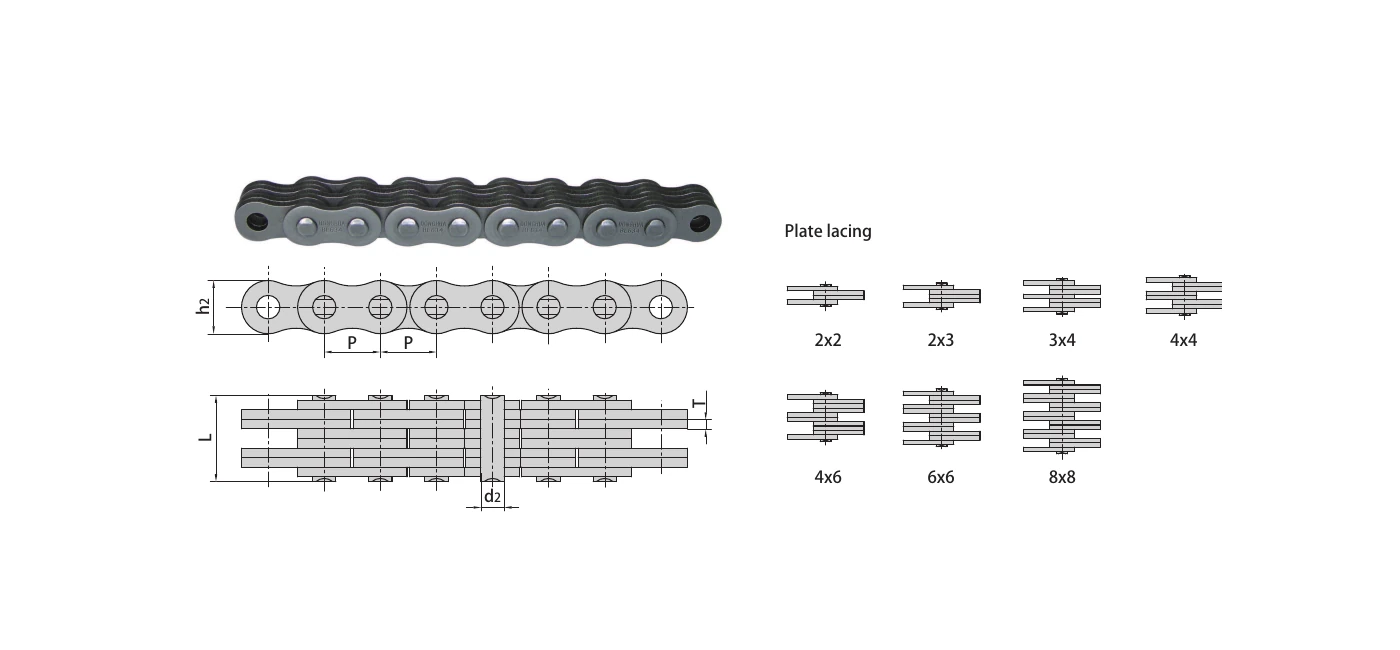
Leaf chain is constructed from interlaced plates and pins and works over sheaves rather than toothed sprockets. For a replacement, the fastest reliable path is to identify the chain reference, pitch and lacing, then verify plate depth, thickness, pin diameter, overall pin length and end connection.
For new lifting equipment, working load, duty cycle, shock, operating speed, articulation around the sheave, lubrication and environmental exposure all influence the final selection. A tensile-strength value is not, by itself, a working-load recommendation.
Where Leaf Chains Are Used
Forklift masts
Reciprocating lifting where the chain articulates over sheaves in the mast.
Warehouse stackers
Mast and vertical-lift systems that require compact, high-tensile chain assemblies.
Machine counterweights
Counterbalance and controlled lifting mechanisms in industrial machinery.
Parking and lifting platforms
Lifting systems where end connections, pitch and installed routing must be verified.
Manufacturing and Inspection Priorities
For a leaf chain, plate and pin quality are only part of the picture. Pitch consistency, plate-hole quality, pin fit, articulation, edge condition and finished chain length all affect how the assembly behaves in a lifting system. Our RFQ workflow therefore asks for the installed geometry and application conditions before a replacement reference is confirmed.
Incoming or final inspection can be aligned to the dimensions shown on the approved drawing or chain reference. Where a buyer has a proprietary chain or attachment, samples and drawings are used as the control inputs.
Pitch & length
Verify pitch and overall chain length against the approved reference.
Plate stack
Confirm lacing, plate thickness and plate depth.
Pin geometry
Check pin diameter, length and end style.
Connection fit
Verify clevis, anchor and sheave interfaces before shipment.
Technical Resources for Buyers
Use the guides below to narrow a replacement before sending an RFQ.
Hello world!
Welcome to WordPress. This is your first post. Edit or delete it, then start writing!
Read guide →Tower shop made in China – replacement parts – in Tirupati India Crane Spare Parts Wire Rope Iron Pulley and Casting Iron Wheels with top quality
We – EPG Group the bigge EPT gearbox & motors , vee pulleys, timing pulleys, couplings and gears factory in China with 5 different branches. For more details: Mobile/whatsapp/telegram/Kakao us at: 0086~13083988828…
Read guide →Power made in China – replacement parts – in Nellore India Steering Rack for Subaru Baja Outback with ce certificate top quality low price
We – EPG Group the bigge EPT Chain and agricultural gearbox factory in China with 5 distinct branches. For a lot more specifics: Cellular/whatsapp/telegram/Kakao us at: 0086~13083988828 13858117778 0571 88828 1&time period…
Read guide →Wpka manufacturer made in China replacement parts in Tomsk Russian Federation Gearbox for Transmission Speed Reducer with top quality
We – EPG Group the biggest gearbox & motors , couplings and gears manufacturing unit in China with 5 various branches. For far more information: Mobile/whatsapp/telegram/Kakao us at: 0086~13083988828 13858117778083988828 WPKA gearbox…
Read guide →China made in China – replacement parts – in Amsterdam Netherlands Factory Custom Milling Steel Alloy Differential Side Gear with Shaft with ce certificate top quality low price
We – EPG Team the bigge EPT Chain and agricultural gearbox factory in China with 5 diverse branches. For a lot more details: Cell/whatsapp/telegram/Kakao us at: 0086~13083988828 13858117778 0571 88828 Q:What`s…
Read guide →OEM induction motor small definition Custom made in China – replacement parts – in Soshanguve South Africa Mini Gearbox Housing for Speed Reducer with top quality
We – EPG Group the greatest worm gearbox, couplings and gears factory in China with 5 various branches. For a lot more particulars: Cell/whatsapp/telegram/Kakao us at: 0086~13083988828 13858117778083988828 / Item Description OEM…
Read guide →Composite near me made in China – replacement parts – in Angeles City Philippines Bend Belt Conveyor Drive Pulley for Cement EPT Belt Drive Pulley with top quality
We – EPG Group the bigge EPT gearbox & motors , vee pulleys, timing pulleys, couplings and gears factory in China with 5 different branches. For more details: Mobile/whatsapp/telegram/Kakao us at: 0086~13083988828…
Read guide →High wholesaler made in China – replacement parts – in Newcastle upon Tyne United Kingdom Quality Rolling Shutter Door Motor Side Motor AC800kg with top quality
We – EPG Group the largest gearbox & motors , couplings and gears manufacturing facility in China with 5 various branches. For far more details: Cellular/whatsapp/telegram/Kakao us at: 0086~13083988828 13858117778083988828 Software The…
Read guide →90mm price made in China – replacement parts – in Tunis Tunisia 3-Phase 60W DC Brushless Small AC Gear Motor Spiral Bevel with top quality
We – EPG Team the greatest gearbox & motors , couplings and gears manufacturing unit in China with 5 diverse branches. For far more information: Cell/whatsapp/telegram/Kakao us at: 0086~thirteen 571 88828 13858117778…
Read guide →near me shop made in China – replacement parts – in Edinburgh United Kingdom with top quality
We – EPG Group the bigge EPT gearbox & motors , vee pulleys, timing pulleys, couplings and gears manufacturing facility in China with 5 different branches. For far more details: Cellular/whatsapp/telegram/Kakao us…
Read guide →Diesel near me shop made in China – replacement parts – in Oran Algeria Engine Double Suction Split Casing Centrifugal Irrigation Pump with top quality
We – EPG Group the bigge EPT gearbox & motors , vee pulleys, timing pulleys, couplings and gears manufacturing facility in China with 5 different branches. For more information: Cellular/whatsapp/telegram/Kakao us at:…
Read guide →Dhs made in China – replacement parts – in Abeokuta Nigeria Electric Chain Hoist Electric Crane with ce certificate top quality low price
We – EPG Group the bigge EPT Chain and agricultural gearbox manufacturing facility in China with 5 different branches. For more information: Cell/whatsapp/telegram/Kakao us at: 0086~13083988828 13858117778 0571 88828 Attributes of D…
Read guide →Ready to Match a Chain?
Send the Installed Chain Details
Send the chain reference, lacing, pitch, required length, quantity and application. For replacements, include clear photos, end-connection details and any drawing or marking available.